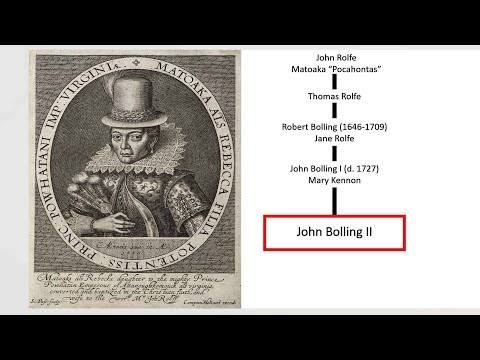
Most people who search for John Bolling are looking for a connection — to Pocahontas, to American history, or to a family tree. That search almost always leads to the same man: Colonel John Bolling of Virginia, born in 1676. He was not a modern celebrity. But his name appears constantly in genealogy databases, ancestry searches, and historical records because of where he sits in one of America’s most documented family lines.
This article covers who John Bolling was, how he connects to Pocahontas, who his family was, and why his name keeps turning up whenever people trace certain American ancestry lines.
Who Was John Bolling?
John Bolling was born on January 27, 1676, at Kippax Plantation in Charles City County, Virginia. He died on April 20, 1729. During his lifetime, he worked as a planter and merchant, served as a military officer, and held a seat in the Virginia House of Burgesses, representing Henrico County.
The House of Burgesses was the elected legislative assembly of colonial Virginia — one of the earliest representative governing bodies in what would become the United States. Serving in it meant John Bolling held real political standing in his community.
He later became associated with Cobbs Plantation, in what is now the Chesterfield County area of Virginia. His life was rooted in land, trade, and local governance — typical markers of prominence in colonial Virginia.
One important clarification: John Bolling had a son also named John Bolling, known as Major John Bolling (1700–1757). These are two different people. The father and son are sometimes confused in online records, so if you see the name without a birth year, always check which one is being referenced.
His Place in Pocahontas’s Family Tree
This is the part most readers are actually looking for. The connection is real, and it follows a clear four-generation line:
Pocahontas → Thomas Rolfe → Jane Rolfe → John Bolling
Here is how that works. Pocahontas and English tobacco planter John Rolfe had one son: Thomas Rolfe. Thomas Rolfe had a daughter named Jane Rolfe. Jane Rolfe married Colonel Robert Bolling, and their son was John Bolling.
That makes John Bolling Pocahontas’s great-grandson — three generations removed from her.
He never met Pocahontas. She died in 1617, nearly sixty years before he was born. There was no overlap in their lives at all.
John Bolling is widely described in genealogical records as the only surviving child of Jane Rolfe and Robert Bolling. This is why his name is so central to this family line. If you are tracing descent from Pocahontas through Jane Rolfe, John Bolling is the person that line passes through. A more precise way to put it: he was the only surviving child of Jane Rolfe, and the documented American line through her runs directly through him.
It is worth being careful here. Not every person with the Bolling surname is a descendant of Pocahontas, and not every online family tree that claims this connection has been verified against primary records. If you are building your own family tree, check whether the line actually passes through Thomas Rolfe and Jane Rolfe before accepting the claim.
His Marriage and Children
John Bolling married Mary Kennon on December 29, 1697. Together they had at least six children, according to genealogical sources.
Among the children identified are:
- Major John Bolling (1700–1757)
- Jane Bolling Randolph
- Martha Bolling Eldridge
- Anne Bolling Murray
The breadth of this family is one reason John Bolling’s name appears so frequently in ancestry databases. He had multiple children, those children had their own large families, and the line spread considerably across Virginia and beyond in the generations that followed.
Some genealogy sources refer to the descendants of John and Mary Bolling as the “Red Bollings.” This is an informal genealogy label, not a standardized historical term. It appears in compiled family-history resources and can be useful for identifying which branch of the Bolling family is being discussed, but it should not be treated as an official classification.
One notable descendant connected to this line through later generations is Edith Bolling Galt Wilson, who became the second wife of President Woodrow Wilson. Genealogy references cite this connection, though as with any ancestry claim, the full line should be traced carefully rather than assumed from a shared surname alone.
His Role in Colonial Virginia
John Bolling’s life spanned the late seventeenth and early eighteenth centuries — a period when Virginia’s plantation society was firmly established and its political structure was taking shape. Wealthy planters like Bolling held land, managed agricultural operations, participated in trade, and served in local government.
His seat in the House of Burgesses placed him among the men who shaped local law and policy. This was not a minor role. The Burgesses represented real governing authority in the colony, and service there required both social standing and local trust.
His military officer status also reflected the layered expectations placed on men of his position. Colonial Virginia expected its prominent families to contribute to civic defense as well as commerce and governance.
It would be an overstatement to call him a dominant force in colonial politics. He was not a governor or a figure of colony-wide fame during his own time. His prominence was regional and rooted in land, family connections, and local service. But within that world, he occupied a respected position.
Why His Name Keeps Appearing in Genealogy Searches
The simplest answer is this: John Bolling sits at a critical point in a very well-documented family line. He connects the early Virginia colony — specifically Pocahontas’s immediate family — to many American descendants who came after him.
Because he was the only surviving child of Jane Rolfe, he is the single path through which descent from Pocahontas in that direct line is traced. Anyone researching this ancestry has to pass through him. That is why databases, family trees, and historical records return his name so consistently.
His children’s marriages into other prominent Virginia families also extended the network further. When you have multiple children marrying into documented colonial families, the genealogical footprint grows quickly across generations.
For readers using resources like Minify Business or other research tools to organize and verify genealogy connections, John Bolling is a useful anchor point — a well-documented name with confirmed dates, parents, a spouse, and identified children. That kind of documentation is rarer than it might seem for colonial-era figures.
What We Do Not Know
Genealogical records give us a reasonable picture of John Bolling’s family structure, dates, and public roles. What they do not give us is much about the man himself in a personal sense.
There is no reliable record of his personality, his appearance, his private beliefs, or the details of his daily life at Kippax or Cobbs Plantation. A responsible account of his life has to stay within what the historical record supports. Filling in those gaps with assumptions would not serve readers looking for accurate information.
Similarly, any claim connecting him to a specific living celebrity or modern public figure should be verified through a full, traceable genealogical record — not just a shared family name or an unreviewed online tree.
A Straightforward Summary
John Bolling (1676–1729) was a Virginia planter, merchant, and politician who served in the colonial House of Burgesses. He was the great-grandson of Pocahontas through her son Thomas Rolfe and granddaughter Jane Rolfe. He married Mary Kennon in 1697 and had at least six children, whose descendants spread widely across American family lines.
He is not a modern celebrity. His importance is historical and genealogical. He is significant because of where he stands in a documented family tree — as the only surviving child of Jane Rolfe and the starting point of a line that many American families have traced back to Pocahontas.
If you found his name in your own family research, you are likely looking at one of the most carefully documented ancestry connections in early American history. Just make sure the line in your tree actually passes through Thomas Rolfe and Jane Rolfe — and when possible, cross-check what you find online against historical records, wills, land documents, and reputable genealogical sources.
Read Also: