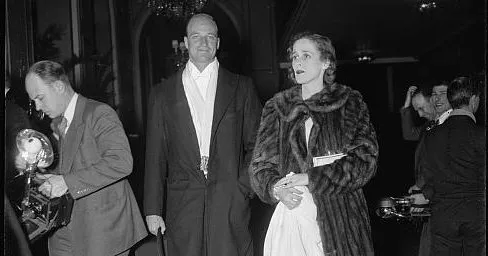
If you have ever searched a genealogy database and found the same woman listed as Betsey Cushing, Betsey Roosevelt, Elizabeth Cushing, and Betsey Whitney, you are not looking at four different people. You are looking at one woman whose life touched several of the most prominent families in 20th-century American history.
This article explains who she was, where she came from, who she married, and why her name shows up in so many different forms across historical records.
Who Was Betsey Cushing Roosevelt Whitney?
Betsey Maria Cushing Roosevelt Whitney was born on May 18, 1908, in Baltimore, Maryland. She died on March 25, 1998, in Manhasset, New York, at the age of 89.
She was not a politician, an actress, or a public official. Her prominence came from her family background, her two marriages into major American dynasties, her philanthropic work, and her involvement in art collecting. Understanding those four areas makes her identity much clearer.
Her death was reported by both the Los Angeles Times and The Washington Post, which described her primarily as a philanthropist and the widow of John Hay Whitney.
Her Family Background and the Cushing Sisters
Betsey’s father was Harvey Williams Cushing, one of the most important medical figures of the early 20th century. He is widely credited with founding modern neurosurgery. Her mother was Katharine Stone Crowell Cushing.
Growing up as the daughter of a famous surgeon gave Betsey a certain standing from the start. But the Cushing family became even more socially significant through its three daughters.
Betsey was one of three sisters known collectively as the Cushing sisters. Her sisters were Barbara Cushing, known publicly as Babe Paley, and Mary Cushing, known as Minnie, who later became Minnie Astor Fosburgh. Each sister married into a different prominent American family — one connected to media, one to the arts, and one to politics and finance.
It is worth being specific here: Babe Paley and Minnie Astor Fosburgh were Betsey’s sisters. They were not alternate names for Betsey. Genealogy searches sometimes pull up all three sisters together, which can create confusion.
Her First Marriage and the Roosevelt Connection
In June 1930, Betsey married James Roosevelt II. James was the eldest son of Franklin D. Roosevelt and Eleanor Roosevelt.
This is a point that often needs clarification. Betsey was not Franklin D. Roosevelt’s daughter. She was his daughter-in-law. That distinction matters, especially in genealogy records where the Roosevelt name attached to her can suggest a closer blood relationship than actually existed.
Betsey and James Roosevelt had two daughters together. Sara was born in 1932, and Kate was born in 1936.
When Franklin D. Roosevelt became president, the White House required a great deal of social coordination. Eleanor Roosevelt had many public duties and was frequently away. On some occasions, Betsey helped with White House hosting during those absences. She did not hold any official government or White House position. Sources describe her role as informal assistance with hosting, not a formal title or appointment.
The marriage to James Roosevelt eventually ended in divorce. It left Betsey with the Roosevelt surname, which she carried into the next chapter of her life.
Her Second Marriage and Life With John Hay Whitney
On March 1, 1942, Betsey married John Hay Whitney, known to friends as Jock. This marriage would define much of her later public identity.
John Hay Whitney was a significant figure in American life. He was a wealthy publisher, investor, and philanthropist with deep ties to American art and culture. He later served as U.S. Ambassador to the United Kingdom under President Eisenhower, a role he held from 1957 to 1961.
Betsey accompanied her husband to Britain during his diplomatic posting and was part of the social environment that surrounded that service. She was not herself a diplomat or ambassador. That role belonged to John Hay Whitney alone.
The Whitney name connected Betsey to major American cultural institutions. The Whitney Museum of American Art, while founded before her marriage, carried the family name. The John Hay Whitney Foundation was another institution tied to the family’s philanthropic legacy. Betsey served on boards connected to these and other organizations.
John Hay Whitney died in 1982. Betsey survived him by more than fifteen years.
Philanthropy and the Greentree Foundation
After John Hay Whitney’s death, Betsey established the Greentree Foundation in 1983. The name came from Greentree, the family’s Long Island estate. The foundation focused on supporting community groups and organizations across several areas, including health, education, and the arts.
Betsey’s charitable interests were broad. According to her Los Angeles Times obituary, she supported medicine, education, art, and local community organizations throughout her life. She served on various institutional boards and remained active in philanthropic work well into her later years.
Her approach to giving was not limited to writing checks. She served in board roles and took an active interest in the organizations she supported.
Art Collecting
Betsey was also connected to significant art collecting, largely through her life with John Hay Whitney. The collection associated with the Whitney household included major works of art.
One frequently cited example is a Renoir painting, At the Moulin de la Galette, which sold in 1990 for $78.1 million. According to the Frick Art Research Library, that figure was a record for Impressionist art at the time. It is important to note that this single sale should not be taken as a measure of the entire collection’s value, but it gives a sense of the caliber of works involved.
Betsey also made significant art bequests to the National Gallery of Art, further cementing her place in American cultural philanthropy.
Why Her Name Appears in So Many Variations
This is the question that sends many readers searching in the first place. The short answer is that each name reflects a different stage of her life.
- Betsey Cushing — her name at birth, using her father’s surname.
- Elizabeth Cushing — a formal variant of her first name. Betsey is often a nickname for Elizabeth, and some official records used the longer form.
- Betsey Roosevelt or Betsey Cushing Roosevelt — the name she carried during and after her first marriage to James Roosevelt.
- Betsey Whitney or Betsey Cushing Roosevelt Whitney — the full name she used after her second marriage to John Hay Whitney.
Genealogy databases, historical newspapers, and archival records do not always agree on which version to use. Some use the formal legal name, some use the most commonly recognized version, and others use the name she was known by at a particular point in time. That inconsistency is normal and does not indicate an error in the underlying records.
If you are building a family tree and find her listed under any of these names, you can cross-reference the birth year (1908), the birthplace (Baltimore, Maryland), and the names of her two husbands — James Roosevelt and John Hay Whitney — to confirm you have the right person.
For readers looking at broader topics in American social and cultural history, resources like Minifybusiness can offer additional context on how prominent families shaped institutions and public life across generations.
A Summary of Her Life
Betsey Cushing Roosevelt Whitney lived 89 years across a remarkable range of American social history. She was the daughter of a pioneering surgeon, the sister of two socially prominent women, the daughter-in-law of a sitting U.S. president, and the wife of a diplomat and major cultural patron.
She was not a famous figure in the way that politicians or entertainers are famous. Her prominence was quieter — built through family connections, institutional service, and philanthropic work that extended well beyond her husband’s death.
The multiple surnames attached to her name are simply the record of a life that moved through several distinct chapters. Each name is accurate for its time. Together, they tell the story of one woman who was, at different points, a Cushing, a Roosevelt, and a Whitney.
Read Also: