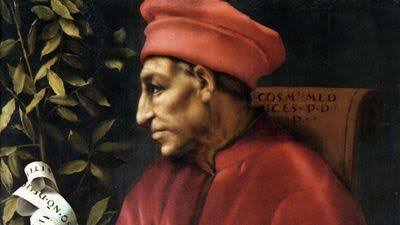
Two men named Cosimo de’ Medici shaped Florence across very different centuries — and people mix them up constantly. Search results, portrait labels, and family-tree databases all use the same name for both. Before anything else, it helps to know which Cosimo you are actually reading about.
This article is about Cosimo I de’ Medici (1519–1574) — the man who became Duke of Florence at 17, conquered Siena, and eventually became the first Grand Duke of Tuscany. His story goes well beyond art patronage.
Cosimo I de’ Medici and Cosimo the Elder Are Not the Same Person
This is the single most common point of confusion, so it is worth clearing up right away.
Cosimo the Elder lived from 1389 to 1464. He was a banker and political operator who built the early foundation of Medici power in Florence. He never held a formal ducal title. He worked largely behind the scenes.
Cosimo I lived from 1519 to 1574 — more than a century later. He held official titles: first Duke of Florence, then Grand Duke of Tuscany. He governed a formal territorial state with real military force behind it.
The quickest way to tell them apart is by dates and titles. If the name “Cosimo de’ Medici” appears without a birth year or title attached, check the context carefully. Even portrait captions labeled “Cosimo de’ Medici” do not always depict Cosimo I. Encyclopaedia Britannica maintains separate biography entries for each man — a useful reminder that they are distinct historical figures.
His Place in the Medici Family and How He Rose to Power
Cosimo I was not the obvious heir to Florence’s leadership. He came from a branch of the Medici family that was not at the center of power. According to Britannica, he was a great-great-grandson of Lorenzo de’ Medici — the famous Lorenzo the Magnificent — but through a line that was somewhat removed from the main ruling circle.
His path to power opened suddenly and violently. In January 1537, his distant cousin Alessandro de’ Medici was assassinated. Alessandro had ruled Florence as duke, and his death left a political vacuum with no clear successor.
Florentine power brokers chose Cosimo, then just 17 years old, to fill the role. Their reasoning was partly practical and partly miscalculated. Influential figures believed the young man would be easy to manage — a figurehead they could steer from behind. They were wrong. Cosimo moved quickly to make his own decisions and build his own authority.
How Cosimo Consolidated Power and Expanded Florentine Territory
From the start, Cosimo had no interest in being a symbolic leader. He worked to centralize authority and eliminate political opposition.
One of his most important early moves was securing the backing of Holy Roman Emperor Charles V. That imperial support gave him the stability to suppress challenges to his rule and gave outside powers a reason to recognize his authority as legitimate.
His governing style was firm and centralized. Reference sources describe it as authoritarian. Florence had a long tradition of republican government — or at least the appearance of one — but Cosimo shifted that decisively toward hereditary princely rule. He was building something closer to a modern territorial state than a Renaissance city-republic.
The most significant military action of his reign came in 1554, when he launched a campaign against Siena. The campaign succeeded. Siena fell under Florentine control, and with it came nearly all of Tuscany. This was not just a military victory. It was the territorial foundation for the grand-ducal state that would follow.
The Title That Changed His Status — First Grand Duke of Tuscany
In 1569, Pope Pius V formally granted Cosimo the title of Grand Duke of Tuscany. This was a meaningful elevation, not just an honorary gesture.
The title gave official recognition to what Cosimo had spent decades building — a consolidated Tuscan state under Medici control. It placed him above the ordinary Italian nobility and established a formal dynastic rank that his successors would inherit.
It is worth being clear about what this title was not. Cosimo was not a king. The grand-ducal title was specific to Tuscany and distinct from royal designations. Calling him a king would be inaccurate.
He held the title of Grand Duke from 1569 until his death on April 21, 1574. He left behind a dynastic line that continued to govern Tuscany well after him.
The Uffizi Was Built as a Government Building, Not a Museum
Most people know the Uffizi as one of the world’s great art museums. What fewer people know is that Cosimo did not build it as a museum at all.
He commissioned the Uffizi in the mid-16th century as a centralized administrative complex. The building was designed to house government offices, tribunals, guilds, corporations, and courts — all the formal machinery of a functioning state. The Uffizi Galleries’ own institutional description confirms this original purpose.
The architect was Giorgio Vasari, who is also well known as an art historian and biographer of Renaissance artists. Cosimo commissioned the design; Vasari executed it. The famous art collection housed there today developed over time, long after Cosimo’s death.
This detail matters because it says something about how Cosimo thought. He was building infrastructure for a state, not decorating a palace. The Uffizi was a working building first.
Palazzo Vecchio and the Language of Political Power
Cosimo also moved the official seat of Florentine government into Palazzo Vecchio, transforming what had been a civic building into a ducal palace. The move was symbolic as much as practical.
He brought Vasari in again to redesign its interiors. The painted rooms and decorated halls were not just decoration. They were deliberate statements about Medici legitimacy, power, and history. Art and architecture were tools Cosimo used to communicate authority to anyone who walked through the door.
Patronage, Scholarship, and a More Complete Picture
Cosimo did continue the Medici tradition of cultural patronage. He supported artists including Agnolo Bronzino, whose portraits of the Medici family remain among the most recognizable images of the period. He also worked with sculptor Bartolommeo Ammannati on architectural projects.
Beyond the visual arts, he sponsored archaeological excavations at Etruscan sites and helped establish the Florentine Academy, an institution focused on the study of the Italian language. These were not small gestures — they reflected a genuine interest in shaping Florentine cultural identity.
But it would be a mistake to remember Cosimo only through the lens of arts funding. The same ruler who commissioned great buildings and supported scholars also expanded his territory through military force and governed with concentrated authority. Both things are true, and a clear-eyed view of his legacy includes both.
For readers interested in how historical rulers balanced culture and control, resources like Minify Business cover the intersection of leadership, strategy, and lasting institutional impact across different eras.
Why Genealogy Researchers Search for Him
Cosimo I comes up frequently in genealogy searches, sometimes because of genuine family-history interest, and sometimes because of surname connections that may not be what they appear.
It is worth being straightforward about this. Sharing the surname Medici, appearing in an online family-tree database, or living in a Tuscan region does not establish descent from Cosimo I. A documented genealogical link requires a connected chain of parent-child records through each generation. Without that documentation, a connection to Cosimo I remains unverified.
The Medici family was large, politically prominent, and spread across centuries. Confusion is understandable. But responsible family history research requires evidence, not just a shared name.
A Quick Timeline of His Life
- 1519 — Born on June 12 in Florence
- 1537 — Becomes head of Florence after Alessandro de’ Medici’s assassination
- 1554 — Military campaign against Siena brings most of Tuscany under Florentine control
- 1569 — Pope Pius V grants him the title of Grand Duke of Tuscany
- 1574 — Dies on April 21, leaving a dynastic line to continue Medici rule
His Place in History
Cosimo I de’ Medici was not the founder of the Medici family, and he was not the same person as Cosimo the Elder. He was something specific: the ruler who transformed Florence from a city with Medici influence into the center of a formal, consolidated Tuscan grand duchy.
He did that through political skill, military expansion, imperial alliances, and careful use of architecture and art as instruments of power. The Uffizi still stands. Palazzo Vecchio still stands. The grand-ducal title he earned in 1569 shaped Tuscan governance for generations after him.
His legacy is real — and complicated. That is probably the most honest way to describe it.
Read Also: